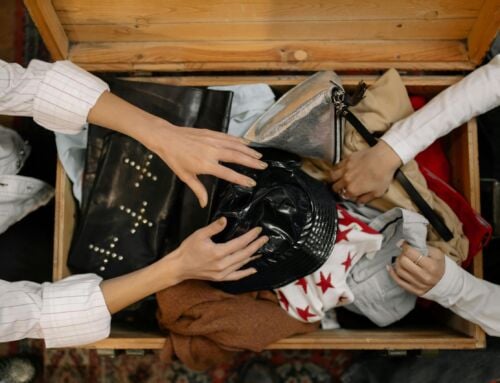
We went to meet Diane Ducasse, a young fashion entrepreneur who founded her women's clothing brand DADA three years ago. The brand celebrates femininity in all its complexity and extravagance through pieces with unstructured, masculine lines. She talks to us about her experiences and her journey to successfully founding her fashion brand.
– Why did you decide to start your own brand? Can you tell me the story of DADA?
Diane Ducasse: I founded it two years ago, but the idea came to me three years ago. It wasn't a dream, it was more of an instinctive and spontaneous decision, without thinking too much about it, because I was guided by my instincts, it just came to me. I was at a point in my life where I could afford to do it.
I was doing quite a bit of freelance work, and I wanted and needed to do a project that reflected who I am from start to finish. It's not always easy to stick to a brand's codes. So, by necessity, it was more of a personal need than a real ambition. And then the wheels started turning. On the one hand, it's really interesting, but on the other, it's pretty scary!
– So you are currently involved in several activities at once?
Exactly. In addition to designing collections for my brand, I teach fashion design at a fashion school and work as a freelancer for Inès de La Fressange for over two years. I don't live solely off DADA, but it's above all a choice.
Today, my brand is not my priority, because I need another job on the side, one that allows me to take a step back and make new contacts so I can expand my network. In fact, I have to admit that I like doing lots of things at the same time.
– Can you tell me about your background and your studies?
I did a science baccalaureate and then a preparatory course for HEC business school, then I went to the United States for a while. When I came back to Paris, I applied to a fashion school and studied there for a year and a half.
From there, I was accepted for an internship at Lanvin directly into the second year, then at Marc Jacobs. I also worked at Michel Vivien, where I worked on designing accessories and shoes. Finally, for a year, I was the right-hand man of Vincent Darré, the decorator and stylist.
Thanks to this experience, I got to try my hand at everything and met lots of very interesting people. Then I started doing freelance work, making lots of shoes and bags.
– How long did it take you to create your brand? From the moment the idea first came to you to the moment you actually founded it?
Three years. I thought about launching the brand in September 2015, and in October I was coming up with a name, starting to look for suppliers, workshops... Then I started designing the first pieces. And the brand was created and registered in February 2016.
– Did you decide to go it alone? Why?
Yes, I started out on my own, and to be honest, I didn't really think about it too much. Actually, I think I find it a little difficult to delegate. It's a way of being able to do what I really want to do. Originally, I wanted to do a project that reflected who I am from start to finish, so being on my own gave me a lot of freedom in that regard.
It's clear that now, with the brand's growth, I'm going to need to surround myself with people. I'm still on my own today because it's difficult to find the right people who are available at the right time. You can't ask everyone to be as committed as you are! But I'm starting to look for a right-hand man, a partner.
– What do you think are the main difficulties and obstacles to creating your own fashion brand?
Personally, I have a real problem with anything administrative. It's not my strong point, I don't really like it. At first, you think you're going to launch your brand and be able to focus entirely on your work as a designer, but then you quickly realize that there are a lot of things you hadn't necessarily considered at the outset. You have to register the company name, do the accounting, create a website...
But, to my surprise, I realized that I liked all of it, simply because I love learning new things. Everything is new, and that can be both very confusing and very exciting.
And then, one of the main difficulties lies in making the right decisions, not messing up right from the start. It's about choosing the right price range, defining your strategy, how to position yourself in the market, etc. And then, of course, finding suppliers and manufacturers, gaining their trust, learning the ins and outs of production... You learn all that on the job!
– What do you think are the key elements for successfully creating your own fashion brand?
Courage, patience, lots of energy, and above all, passion!
– How did you make yourself known? Did you already have a good network? What communication techniques did you establish?
As I gained experience, I managed to build up a fairly large network. But the journalists who wrote about me from the beginning were people I didn't know at all. In fact, the spread of my brand is not necessarily linked to my network. I think it's more related to the product itself and the brand image.
I work hard on the image of my lookbooks. People like the product, it's doing well. I've also noticed that the press really likes my story, the story of how the brand was created. So I've been asked to do a lot of interviews. It's true that the press has been interested in DADA from the very beginning.
– Tell me a little about your image and the importance of social media for your brand.
Originally, social media and I didn't get along! I was one of the few people who wasn't on Facebook or Instagram, so I've come a long way! To be honest, I didn't really like it. When I launched my brand, Instagram was just starting to take off. It wasn't as big as it is now. I didn't really see the point of it, I found the relationships on this kind of app to be rather distorted.
But in the end, I joined Instagram because I ended up finding it really interesting. It's a real job! I try to post every day, as I realized that my customers wanted me to. Nowadays, I have customers who discover me on Instagram, I have the press discovering me on Instagram, and shops are also discovering me on Instagram.
So today I can tell you that it's essential and that I can't do without it. I think that when you're a fashion brand, you can't escape this network.
– What inspires you? Are there any designers who particularly resonate with you?
Yohji Yamamoto, Comme des Garçons, Yves Saint Laurent, Margiela... I love the designers from those years, who deconstructed clothing and made women look very feminine in men's clothes. I try to mix suits, Parisian elegance, nonchalance, deconstruction, New Age...
Otherwise, for my collections, I draw inspiration from films I see, exhibitions I visit, trips I take... But mostly films, it's true. Right now, I have a soft spot for very traditional English style, «hunting and fishing» style clothing. I also draw inspiration from everything Japanese.
– How long does it take you to create a collection?
So, I don't really dare tell you the truth, but actually I put my collections together in an afternoon! In fact, I think about them from morning to night for months on end, so it's still a daily task!
– What is the difference between working as a stylist for a fashion house and working for your own brand?
Firstly, I don't have the same budget and I don't have as many teams working for me. As a result, I'm going to be more confident. Unlike the brands I've worked for, I don't create prototypes only to abandon them in the end.
When I decide on something, it inevitably ends up happening. Otherwise, on a small scale, it works the same way; there aren't a thousand different ways to create collections.
– What advice would you give to those who want to create their own fashion brand?
I think you have to decide to give 100% your all in your company. You have to know that it's a job that requires twice as much energy as most people. You have to be fully committed. The steps are not easy, you have to be brave. There are things that can be difficult to manage, such as relationships with suppliers and manufacturers. You are totally dependent on other people. What I find complicated is not being able to control certain things.
You also need to know how to manage your budget, because making clothes is expensive, often quite expensive. Finally, I think it's essential to have a real identity. Either you need to have a well-established marketing image, or you need to have defined a distinctive style and therefore have a real identity to stand out. I think what people like about my brand is its identity, quality, comfort, and history. I've noticed that my customers are very interested in the story behind the clothes.
– Justement, quel est le rapport avec vos clientes ?
Je suis très proche de mes clientes, on a un rapport presque amical. Je suis très fière de ma clientèle, je me considère très chanceuse. Je pense que le fait de rencontrer la créatrice induit forcément une relation plus intime, plus humaine. C’est très agréable d’avoir ce lien très proche avec elle. Elles me font un vrai suivi, alors qu’elles ne sont pas obligées ! Elles m’envoient des photos des vêtements portés, elles me disent les compliments qu’elles reçoivent…
– Quels sont vos projets ?
J’ai toujours des projets. J’aimerais faire un pop-up store à la rentrée, mais aussi essayer d’organiser des collaborations avec des marques que j’aime. Je pense que c’est une chose qui fonctionne bien, pour se faire connaître, élargir sa clientèle, et puis pour connaître d’autres personnes aussi. J’aimerais également beaucoup faire de la chaussure, faire des capsules, et enfin faire des collections Homme. J’ai aussi très envie d’ouvrir une boutique. Il y a pleins de choses à faire !
– Où peut-on trouver vos créations ?
Sur mon site internet. J’ai aussi un appartement showroom dans le sixième arrondissement de Paris. Mes pièces sont aussi revendues chez des retailers. Mais mes meilleures ventes sont des ventes directes, donc au sein du showroom, des pop-up stores ou sur l’e-shop. Mes pièces sont également vendues à l’étranger.
If you want even more tips on launching your brand, you can read our article on How to launch your fashion brand in 5 essential questions.